


If you are researching mini cranes for positioning doors, start with five questions:
1. How much does the complete suspended load weigh?
Include the door, frame, glass, hardware, slings, spreader beam, vacuum lifter, and other lifting accessories.
2. How narrow is the access route?
Measure the narrowest gate, doorway, side passage, turning area, and overhead clearance.
3. How far must the door be positioned?
Crane capacity changes with working radius, boom length, lifting height, and outrigger configuration.
4. What surface will support the crane?
Check paving, concrete, cobblestone, finished floors, landscaping, slopes, and underground structures.
5. How precise is the final placement?
A door that must be aligned with a finished frame may require proportional control, smooth slewing, and controlled rigging, rather than simple vertical lifting.
A mini crane can be useful when a door is too heavy for safe manual handling but the site is too restricted for a conventional mobile crane or telehandler. The correct machine still depends on the load chart, site conditions, rigging plan, and applicable safety requirements.
Mini cranes are compact lifting machines designed to move and position loads in locations where larger equipment has limited access.
Depending on their chassis and stabilization system, they may also be described as:
· Spider cranes
· Mini crawler cranes
· Compact crawler cranes
For door installation, the crane is normally used to lift and control a door or door-and-frame assembly while the installation team guides it into the architectural opening.
The task is not only to raise the load. It may also require: •Controlled horizontal movement •Rotation •Alignment •Temporary holding •Precise positioning near finished walls, glass, flooring, and hardware |
The main application is therefore better described as door positioning rather than simply door lifting.
Internal Link:
[Mini Crawler Cranes] → /product/mini-crawler-crane-p.html
Oversized steel doors, security doors, acoustic doors, glass doors, curtain-wall entrance systems, and doors with heavy frames can exceed the safe handling ability of a small installation crew.
Manual carrying also becomes more difficult when the route includes:
· Steps
· Corners
· Slopes
· Finished surfaces
Mechanical lifting can reduce the amount of manual carrying and improve load control. It does not remove the need for qualified installers, correct rigging, load control, and a site-specific lifting method.
In new residential construction, the entrance may be located behind a boundary wall, at the end of a narrow driveway, or beside completed landscaping.
In commercial projects, a door may need to be moved through a loading area, atrium, lobby, or restricted service route.
A compact crane for heavy doors can be considered when the equipment must travel closer to the opening than a larger lifting vehicle can reach.
The machine must still be checked against the actual:
· Route width
· Turning space
· Floor loading
· Overhead obstructions
· Setup area
Positioning a door into a frame can involve very small adjustments.
The installation team may need to control the load while checking:
· Sill alignment
· Hinge-side clearance
· Frame position
· Weather seals
· Glazing
· Surrounding finishes
A machine with smooth proportional control and stable outrigger support may be easier to use for this type of controlled movement than equipment intended mainly for transport or rough placement.
The appropriate lifting method varies by door construction, total weight, lifting attachment, and site conditions.
Mini cranes may be considered for several types of heavy doors and entrance systems.
Steel security doors can include thick panels, reinforced frames, multi-point locking systems, specialized security components, and heavy hardware.
The lifting plan should account for the complete door assembly, rather than the door panel alone.
Glass doors and framed glazed entrances require particular attention to:
· Vacuum lifting equipment
· Edge protection
· Sling angles
· Visibility
· Load stability
A mini crawler crane for glass door installation should be paired with a lifting attachment designed for the specific glass and frame configuration.

Internal Link:
[Mini Crawler Crane] → /product/mini-crawler-crane-p.html
Large timber, steel, aluminium, or composite entry doors may be too heavy or awkward for manual positioning.
This is especially relevant when the entrance is elevated or located along a narrow side path.
Hotels, offices, retail spaces, hospitals, and high-end residential projects may use large entrance assemblies with:
· Concealed closers
· Automatic operators
· Thermal breaks
· Special glazing
· Heavy frames
These assemblies often require careful positioning to avoid damage to surrounding finishes.
Transport width is one of the first specifications to check.
Compare the machine's narrowest travel width with the smallest point on the access route.
Also check:
· Machine length
· Machine height
· Turning radius
· Track footprint
· Gate width
· Wall clearance
· Steps
· Overhead clearance
· Outrigger deployment space
A route that is wide enough for travel may not provide enough room for setup.
Do not select a crane based only on its headline maximum capacity.
Review the rated capacity at the actual working radius and boom configuration.
The calculation should include:
· Door or door-and-frame weight
· Glass and hardware
· Slings, shackles, spreader beams, or vacuum lifters
· Temporary lifting frame
· Distance from the crane centre to the installation point
· Required lifting height
· Boom angle
· Outrigger position
· Ground condition
A crane that can lift a certain weight close to its base may have significantly less capacity at a longer working radius.
Check whether the crane can reach the top of the door frame while maintaining the required capacity.
A machine may have sufficient capacity near the base but less capacity at a longer radius or greater lifting height.
Working height, radius, boom configuration, and load weight should be evaluated together.
Compact cranes usually require outriggers or stabilizers for lifting.
The fully deployed footprint may be much wider than the transport width.
Before setup, confirm:
· Available outrigger space
· Ground-bearing conditions
· Surface condition
· Ground protection
· Load-spreading requirements
Finished pavers, cobblestone, landscaping, and underground structures may require additional review.
For door positioning, the operator needs to make small, controlled movements.
Proportional controls, smooth slewing, and clear load visibility can be useful.
The control system should still be evaluated together with operator training and the site's communication plan.
Mini cranes may use:
· Diesel
· Gasoline
· Battery
· Electric
· Dual-power systems
Indoor and semi-enclosed work may have additional requirements for:
· Exhaust
· Ventilation
· Noise
· Electrical supply
Select the power configuration based on the actual working environment rather than assuming one configuration fits every door installation.

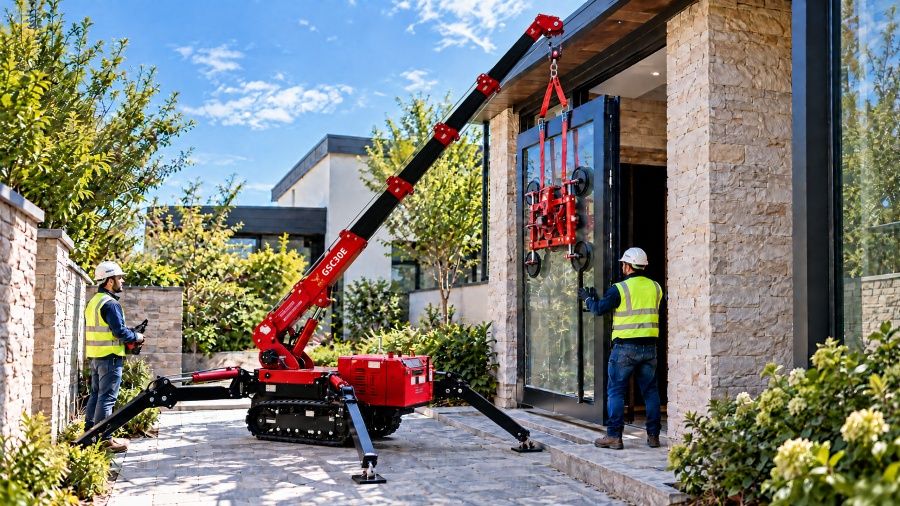
The GLT GSC30D spider crane provides an example of compact lifting equipment for restricted-access door positioning.
In this type of residential application, the crane can be positioned on a narrow paved pathway outside a modern villa. With its outriggers deployed, the machine can operate close to the entrance while a steel-and-glass entry door is positioned near the architectural opening.
This illustrates a common reason contractors research a mini crane for door installation: the entrance may be close to finished stonework, glass, landscaping, and steps, while the access route may not accommodate a larger lifting vehicle.
Application note:
The image is an application example. It does not confirm that every door, route, load, or lifting configuration is suitable. A real project requires a load assessment, access survey, capacity check, rigging plan, and safety review.
Internal Link:
[GSC30D Spider Crane] → link to your GSC30D product page
???? step1 | Confirm the Complete Load Obtain the weight of the Door, Frame, Glazing, Hardware, Lifting attachment, and Rigging. If the manufacturer provides separate weights for the door leaf and frame, calculate the heaviest planned lifting configuration. |
???? step2 | Survey the Route and Setup Area Measure the route at its narrowest points. Record overhead clearance, slopes, corners, steps, surface type, drainage covers, underground structures, and final frame location. |
???? step3 | Select the Lifting Attachment Choose slings, spreader beams, vacuum lifters, lifting clamps, or another approved attachment based on the door material and lifting points. Glass and finished door surfaces may require additional protection. |
???? step4 | Check the Load Chart Verify capacity at the required Radius + height + boom length + outrigger position. Include the weight of all lifting accessories and confirm that the planned lift remains within the applicable rated capacity. |
????️ step5 | Protect the Support Surface Use suitable mats or load-spreading measures where required. Finished pavers, cobblestone, landscaped soil, raised flooring, and underground voids may require additional engineering review. |
???? step6 | Establish Communication & Exclusion Zones Define the roles of the operator, signal person, installers, and site supervisor. Establish an exclusion zone and keep personnel away from fall zones, pinch points, and swing areas. |
⚖️ step7 | Test the Load Before the Full Lift Perform a controlled initial lift to confirm load balance, rigging position, attachment security, and communication. Stop the operation if the load tilts unexpectedly or the rigging behaves abnormally. |
???? step8 | Position and Secure the Door Move the door slowly into the opening using guide ropes or approved handling methods. Keep workers away from pinch points and secure the door or frame before removing lifting equipment. |
A mini crane may not be suitable when:
· The route cannot support the machine
· The setup area is too small for the outriggers
· The load chart does not provide enough capacity at the required radius
· Ground conditions are unsuitable
· The suspended-load risk cannot be adequately controlled
Other options may include a:
· Material lift
· Vacuum lifting system
· Gantry
· Telehandler
· Forklift
· Truck-mounted crane
· Specialized glazing contractor
The best solution depends on the total load, access route, lifting height, working radius, surface, schedule, and applicable regulations.
The frame and lifting accessories can add significant weight.
Always calculate the complete suspended load.
The crane may fit through the gate but fail to navigate a corner, slope, step, or setup area.
Survey the complete access route, not only the entrance.
A compact transport width does not mean the crane has the same lifting footprint.
Confirm the space required for full stabilization.
Crane capacity varies with configuration.
Always use the applicable load chart for the actual lift.
Installers should remain clear of crush zones.
They should not place themselves between a suspended door and a fixed frame or wall.
Mini cranes are used to lift, move, rotate, and position heavy doors or door-and-frame assemblies where manual handling is difficult and larger cranes cannot access the site.
They can be useful for narrow residential paths, finished buildings, glazed entrances, and restricted commercial sites.
Mini crane is a broad term for compact lifting equipment.
Spider crane usually refers to a compact crane with multiple outriggers that create a spider-like support footprint.
Mini crawler crane generally emphasizes a tracked chassis for travelling around a jobsite.
Terminology varies by manufacturer, so compare the actual transport dimensions, load chart, chassis, and stabilization system.
The required width depends on the specific crane model and configuration.
The route must also allow for:
Turning
Safe travel
Overhead clearance
Outrigger deployment
Final setup
Measure the narrowest point and compare it with the manufacturer's transport dimensions.
It may be possible when the crane capacity, lifting attachment, glass type, rigging method, and site conditions are suitable.
Glass installation requires an approved lifting attachment and procedures that protect the glazing and control the load. A general-purpose hook is not necessarily appropriate for every glass assembly.
Capacity should be based on the complete rigged load at the actual working radius and height.
A door that weighs less than the crane's maximum rated capacity may still exceed the allowable capacity when positioned at a longer radius or with a different boom configuration.
Some compact crawler cranes use rubber tracks that can help reduce surface impact, but the machine and outriggers still impose loads on the ground.
Use suitable surface protection and confirm ground-bearing conditions before operation.
A lift plan may be required by the project, employer, site owner, or local regulations.
Even when a formal plan is not required, documenting the load, route, crane configuration, rigging, ground conditions, communication, exclusion zone, and emergency procedure is good practice.
Mechanical lifting can reduce manual carrying and improve control when a door is heavy, awkward, or difficult to align.
It does not automatically make the task safe. The crane, rigging, operators, installers, and site controls must all be appropriate for the lift.
A 3-ton-class spider crane may be suitable for some heavy-door applications, but maximum tonnage alone does not determine suitability.
The selection should be based on:
Complete suspended load
Actual working radius
Required lifting height
Boom configuration
Outrigger position
Lifting attachment
Applicable load chart
Mini Crane Application Guide
For heavy door installations in narrow-access areas, the task goes beyond simple lifting. It demands comprehensive control:
Controlled horizontal movement & rotation
Precise alignment & temporary holding
Safe positioning near finished walls, glass, flooring, and hardware
To determine the ideal crane configuration and attachment, please consider your project details:
Door weight
Access width
Door dimensions
Ground or floor condition
Required lifting height
Door material
Lifting method or attachment
GLT LIFTS can help identify a suitable mini crawler crane configuration for your project.
Request a Crane Recommendation Explore Mini Crawler Cranes
Mini cranes for positioning doors are most relevant when a door is heavy, access is restricted, and the final installation requires controlled alignment near finished architecture.
The selection process should focus on:
Complete rigged load + working radius + route dimensions + outrigger footprint + ground conditions + lifting attachment + site safety.
A compact spider crane or mini crawler crane can solve an access and positioning problem, but it should be selected from verified load-chart data rather than maximum capacity alone.
For a specific project, compare the door dimensions and weight with the crane configuration, then confirm the route and lifting method with qualified personnel.
